Introduction: The Digital Expansion of the GCC
The GCC region has seen most of the rapid digital transformation in the world. Saudi Arabia’s Vision 2030 and the Gulf Cooperation Council’s (GCC) member countries’ use AI to support governance and grow its fintech sectors, among other projects. This is an indication of how rapidly digital infrastructure has changed the business landscape in the GCC.
Cloud-based services and smart infrastructure are on the rise, along with increasing preferences toward becoming connected ecosystems. This has resulted in businesses, governments, and individuals being reliant on digital solutions for much of what they do.
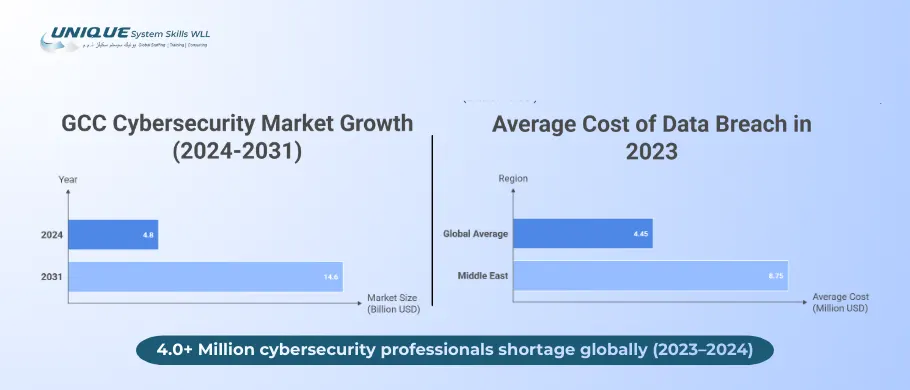
Therefore, Cybersecurity is no longer regarded solely as an IT function. The migration away from paper to digital systems and processes over the past few years has made cybersecurity a backbone of how we operate. So, today’s graduates are looking for Cybersecurity Job Opportunities that are secure, strong, and future-focused. Industry estimates suggest the market could grow from around $4.8 billion in 2024 to nearly $14.6 billion by 2031, showing how critical digital protection has become.
The Cybersecurity Skills Gap Report 2025 report shows that globally, the workforce deficit for Cybersecurity stands at over 4 million Professionals, and the Middle East region is among the top global regions needing qualified Cybersecurity professionals. This growing demand means that graduates need to understand the skills and abilities needed to work in these roles.
Examination of Global and Local Cybersecurity Job Opportunities
The growing popularity of AI, automation, and the cloud have dramatically increased the number of Cybersecurity Job Opportunities available throughout the world. Traditional businesses are now creating automated digital ecosystems powered by AI and big data. This has added more vulnerabilities to these businesses’ systems.
Industries in the GCC specifically (oil & gas, aviation, banking, healthcare and smart cities) are working to establish comprehensive Cybersecurity programs. Major cities like Dubai and Riyadh are investing extensively in the creation of AI -based infrastructure, and as a result continue to create high demand for individuals skilled in cybersecurity to secure this infrastructure. Organizations are placing a high priority on individuals who can identify risk, mitigate breaches, and maintain compliance with international standards.
IT Security Jobs Demand in 2026
IT security jobs demand throughout the GCC has motivated many recent government-backed strategies, newly enacted regulations and an increase in cybercriminal activity.
National-level strategies like Saudi ‘s Vision 2030 and Saudi National Cybersecurity Authority (NCA) is emphasizing on creation of an effective response to risk for Governments and Organizations. GCC countries are strengthening cybersecurity through national initiatives like the Saudi National Cybersecurity Authority, the UAE Cybersecurity Council, and Qatar’s Qatar National Cybersecurity Strategy.
Cybercriminals are now employing more sophisticated methods of committing attacks.
These include utilizing current technologies such as AI to create phishing emails, system locking malware and deepfake videos. The average cost of a data breach according to IBM’s 2023 Cost of a Data Breach Report, was estimated to be over $4.45 million per incident. Along with governments, these reports have compelled many companies to invest heavily in preventing future data breaches. Reports show that a single data breach in the Middle East costs companies about $8.75 million on average, which is significantly higher than the global average.
This surge in demand is opening distinct pathways for 2 types of professionals.
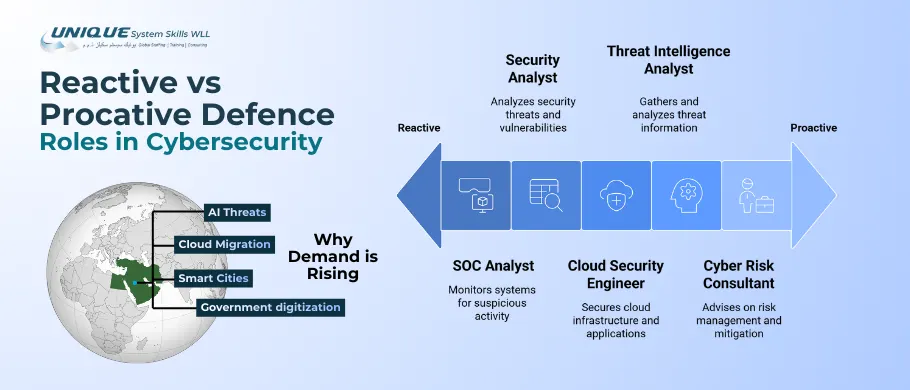
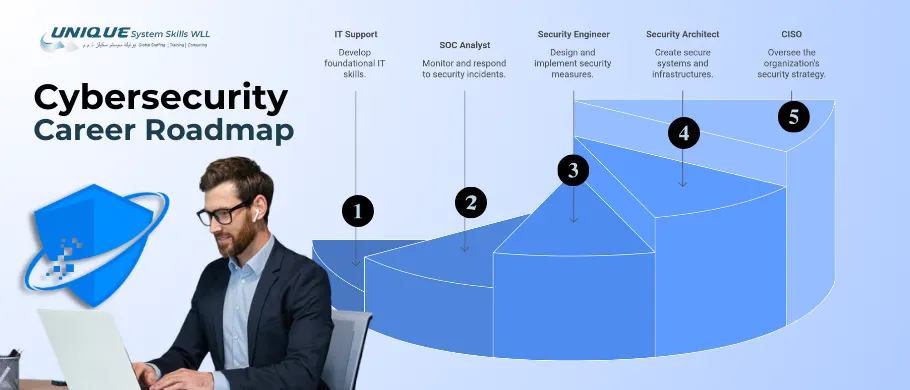
- For fresh graduates, this offers an entry into the domain with Entry-level roles such as Security Analyst, SOC Analyst, and Risk Associate.
- For professionals thinking of switching their field, the industry also provides a strategic pivot. Professionals from IT support, networking, cloud, compliance, or even non-technical domains can leverage their existing experience and layer cybersecurity expertise on top. It might also become an advantage in areas such as governance, risk management, cloud security, and incident response.
How to Begin Your Entry-Level Cybersecurity Jobs
Finding your first job in cybersecurity may seem intimidating, but there are many resourceful methods available to help you start your journey. Entry-level Cybersecurity Jobs can be found across many disciplines, including a SOC Analyst, Junior Information Security Specialist, IT Support Security Associate, Threat Monitoring Analyst, etc.
The trend among employers is moving from valuing purely theoretical knowledge to also recognizing hands-on experience as a valuable asset. By learning how to use products such as Kali Linux, Wireshark, and Metasploit, beginners can obtain real-world experience within their niche.
CFT challenges are very helpful to understand where you stand. The goal of each CTF challenge is to find a hidden file or piece of information (the “flag”) somewhere in the target environment. They have gained popularity in recent years, with an increase from 80 in 2015 to 200+ in 2021.
As long as you’re skilled enough and can showcase that skill to the recruiter, you should be able to find employment in the ever-growing opportunities for cybersecurity professionals, even without traditional IT experience.
Maintaining a portfolio is one of the best ways to increase the chances of getting hired. Create a GitHub account and upload your security project documentation.
Once you have developed the foundational skills, your next step should be pursuing Cybersecurity Certifications.
Career Catalyst: Cybersecurity Jobs After Certification
The number of Cybersecurity Jobs after Certification that you can access can multiply, particularly in the GCC region, as most employers prefer global certification.
For example, the CompTIA Security+, Certified Ethical Hacker (CEH), and Certified Cybersecurity Technician (CCT) all have very similar purposes, from practical knowledge to meet common industry challenges.
Certification credentials have helped to diminish what some have referred to as the “degree paradox,” where academic qualifications does not reflect or guarantee that the person possesses the necessary skills to be successful on the job.
Therefore, with the majority of employers hiring according to certifications, this has opened up the world of Cybersecurity Job Opportunities to many individuals who are willing to pursue formal education and gain validated skill sets.
Certified individuals typically will have accelerated advancement with respect to compensation than those who are not certified. In addition to Certifications being highly valued, specializations within Cybersecurity are becoming even more vital.
Strategic Specializations: From Cloud Security to Zero Trust
The areas of specialization within the cybersecurity ecosystem include the following:
- Cloud Security Engineering
- AI Security Analysis
- Digital Forensics
- Threat Intelligence
- Zero Trust Architectures
All of these are experiencing rapid growth worldwide and within the GCC.
As a lot of startups utilize hybrid cloud environments, they need professionals to protect distributed infrastructures. Financial and government institutions need to implement ’Zero Trust Architectures’, where the underlying principle is to “never trust, always verify”. Financial hubs like the Abu Dhabi Global Market and Dubai International Financial Centre enforce strict cybersecurity compliance.
As these developments occur, they will continue to create new Cybersecurity Job Opportunities for professionals who have technical know-how as well as strategic thinking.
But there is another piece of this puzzle that individuals tend to overlook. Often, leadership, communication, and risk management skills that one possesses can help to determine how much they would advance in their career. These skills especially matter for senior roles like Security Architect and Chief Information Security Officer. Certainly, possessing technical acumen will help open some doors; however, developing your interpersonal skills will ultimately lead to continued career success.
Training institutions, which align their curriculum with industry needs, can more effectively assist professionals on their career paths.
Interview Preparation to Land a Job
The interview is where you prove your work. Here is how to prepare in simple terms
- CIA Triad is the most common question. It stands for Confidentiality, keeping data accurate, and Availability.
- Practice Scenarios like If asked what to do if a coworker clicks a bad link, show your logic to disconnect the computer, inform the team, and check for damage.
- Show Your Passion through Explaining how you stay updated, like watching tech tutorials or reading news. Employers love people who keep learning.
Bridging Skills with Industry Needs: Unique System Skills
Training institutions, like us, which align their curriculum with industry needs, can more effectively assist professionals on their career paths.
Unique System Skills provides a practical and industry-aligned curriculum that helps close cybersecurity skills gaps in the region with hands-on labs. Additionally, they provide certification prep, and job readiness training through their programs to enable learners to transition to new careers with confidence.
Many learners looking for jobs in cybersecurity can learn how to crack interviews in this niche, with structured pathways of training courses, while fixing gaps in their cyber skills through skills development programs. This approach to education continues to support how you must be continuously learning in an ever-changing and developing cybersecurity threat environment.
Future Trends Shaping Cybersecurity Careers in the GCC
New developments in AI, IoT, and Smart Infrastructure are changing how we view and prioritize cybersecurity. With the addition of new technologies like autonomous vehicles and digital healthcare records, cybersecurity professionals also add value to the innovation process rather than just being behind the scenes.
Businesses have committed to big changes by moving their operations to cloud-based technology, which will contribute heavily to the growth of legitimate new Cybersecurity Job Opportunities, especially for Cybersecurity Professionals in areas of AI Security, Cloud Governance, and Critical Infrastructure Protection.
Professionals who stay on top of these technological changes can maintain a competitive advantage. Ultimately, it appears likely that long-term opportunities in Cyber Security will be stable and come with a long-term, strategic perspective.
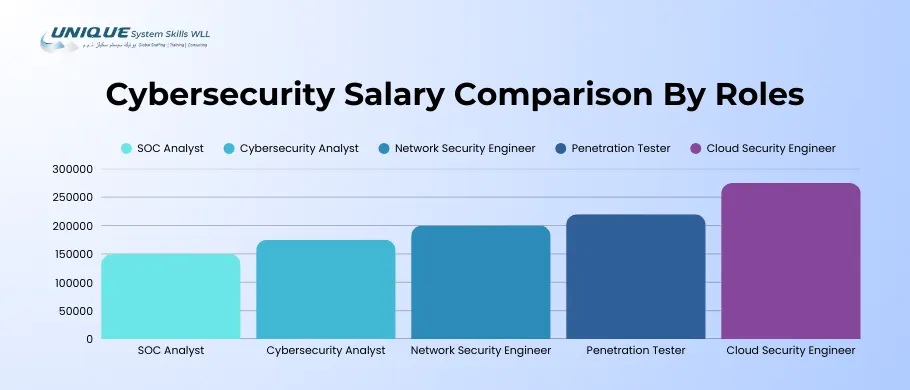
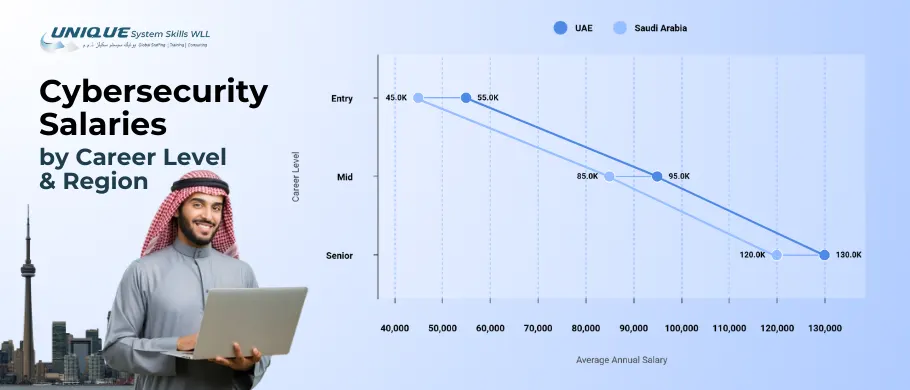
| Role | Saudi Arabia (SAR) | United Arab Emirates (AED) |
| SOC Analyst | 8,000–15,000 | 9,000–18,000 |
| Security Engineer | 18,000–30,000 | 20,000–35,000 |
| Cloud Security | 22,000–35,000 | 25,000–40,000 |
| CISO | 40,000+ | 50,000+ |
Conclusion: Securing Your Future in the GCC Tech Ecosystem
The GCC tech ecosystem offers a variety of career options in Cybersecurity. The Gulf’s commitment to digital transformation continues to create an increasing demand for skilled workers who can protect critical infrastructure, financial systems, and new technologies. Cybersecurity is fast becoming one of the most stable career paths in the greater global technology world.
Whether you’re a student considering your career options, a professional who’s thinking about making a career move, or an IT professional looking for advancement, the rapidly increasing number of Cybersecurity Job Opportunities indicates that long-term prospects are bright.
By developing practical skills, obtaining relevant certifications, and continually adapting to technological change, professionals can grow from a stable baseline into a successful career. Practical training, targeting a specialty area, and utilizing educational resources such as Unique System Skills provide an avenue for education and training that will allow Cybersecurity professionals to have a meaningful, purposeful, and forward-thinking career that will support the security and resiliency of the digital world.
People Also Ask (FAQs)
-
What is the salary of a SOC analyst in the UAE?
In the UAE, SOC Analysts generally earn AED 9,000 to AED 18,000 monthly. Your exact pay depends on your years of experience, specialized certifications, and the current market demand for cybersecurity skills.
-
Can I get into cybersecurity without a degree?
Employers now care more about what you can actually do than just what is on your resume. Having practical skills, official certifications, and a portfolio of projects you’ve worked on will help you get hired. Many people even switch into this field from IT, networking, or completely different jobs by taking the right training.
-
Which certification is best in GCC?
In the GCC countries, certifications like Security+, CEH, and CCT are very popular. These certificates prove you have the right skills and make it much easier to find a job in many different industries.
-
How long does it take to become job-ready?
In the Gulf (GCC) region, certificates like Security+, CEH, and CCT are well-known. They prove you have the right skills and help you get hired more easily in many different fields.