Data science in healthcare is redefining how GCC nations diagnose disease, manage hospitals, and plan for population health — at a speed few regions in the world can match. From Riyadh to Dubai, the Gulf is betting that healthcare data analytics, AI-driven diagnostics, and predictive modelling will solve the chronic disease crisis that economic prosperity has accelerated. This article unpacks exactly how and why it matters now.
What Is Data Science in Healthcare – and Why Does It Matter in the GCC?
Data science in healthcare is the application of machine learning, statistical modelling, and large-scale data analysis to improve patient outcomes, clinical decisions, and operational efficiency. In the GCC context, it matters for three converging reasons.
First, the chronic disease burden is severe. The UAE’s diabetes prevalence sits near 19%; Saudi Arabia’s non-communicable disease rate is among the highest globally. These are conditions that data — not more hospital beds — can help prevent.
Second, GCC governments have written data science into national law. Saudi Arabia’s Vision 2030 Health Sector Programme and the UAE’s National AI Strategy 2031 both commit to digital health transformation with dedicated budgets and regulatory mandates.
Third, the window is open. The GCC is building its health infrastructure from a relatively clean slate compared to Europe or North America, which means it can adopt modern data architectures — cloud-native EHR systems, unified patient identifiers, interoperable platforms — without dismantling legacy systems first.
How Is Data Science Being Used in GCC Healthcare Today?
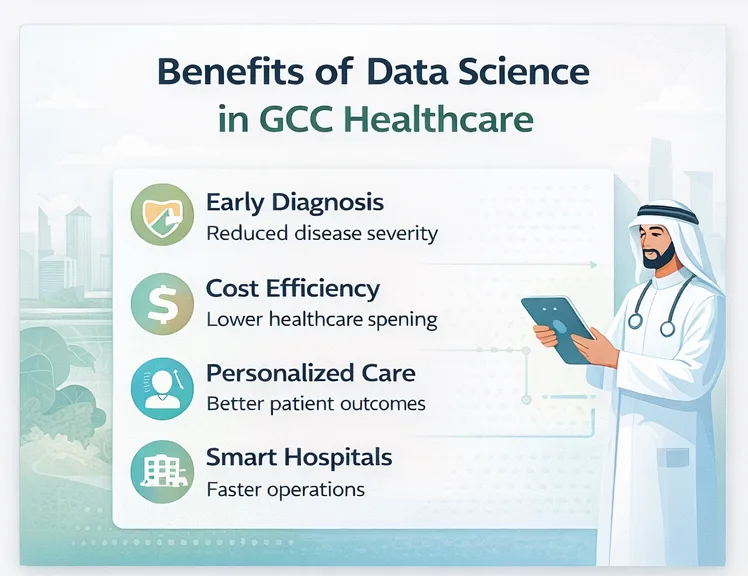
Data science in healthcare across the Gulf is moving beyond pilots into operational deployment. Here are the four primary areas of active use.
Predictive Analytics in Healthcare: Early Disease Detection
Predictive analytics in healthcare allows algorithms to flag high-risk patients before symptoms appear. By processing electronic health records, wearable data, and national population registries, these models identify individuals likely to develop diabetes, cardiovascular disease, or hypertension within three to five years.
Saudi Arabia’s Vision 2030 Health Cluster has piloted predictive screening programmes integrating national health ID data with lifestyle indicators. The Dubai Health Authority has deployed AI-driven risk-scoring tools across its primary care network. The clinical results are still maturing — but the infrastructure is live.
Healthcare Data Analytics in Hospital Operations
Healthcare data analytics is transforming how hospitals run day-to-day. In a region where government hospitals manage tens of thousands of outpatient visits weekly, even marginal efficiency gains have significant human and financial impact.
Predictive bed management systems — forecasting admissions, discharges, and ICU demand up to 72 hours ahead — are deployed in several King Saud Medical City facilities. Abu Dhabi’s Cleveland Clinic affiliate uses real-time dashboard analytics to manage surgical theatre utilisation. Data-driven supply chain tools that model procurement risk and expiry cycles are now a standard requirement in GCC hospital tenders.
AI in Healthcare: Imaging, Diagnostics, and NLP
AI in healthcare is most visible in medical imaging. Deep learning models detect diabetic retinopathy, pulmonary nodules, and certain cancers from imaging data with accuracy comparable to specialist radiologists — critical in a region facing a structural shortage of specialists.
Bahrain’s King Hamad University Hospital has trialled AI-assisted radiology tools. Saudi Arabia’s Health Council has published governance guidelines for AI diagnostic systems — one of the first such frameworks in the Arab world. NLP tools are also being deployed to automate clinical documentation and reduce physician administrative load.
Big Data Healthcare: National Platforms Going Live
Big data in healthcare requires infrastructure before it delivers insight. The GCC is investing heavily here. The UAE’s Malaffi platform — Abu Dhabi’s Health Information Exchange — now connects hundreds of hospitals and clinics into a unified longitudinal patient record. Qatar’s Hamad Medical Corporation has built one of the region’s most advanced enterprise health data warehouses. Saudi Arabia’s Seha platform continues to expand its national coverage.
GCC Healthcare Data Science: Country-by-Country Snapshot
| Country | Key Platform / Initiative | Primary Focus Area | Regulatory Framework |
|---|---|---|---|
| Saudi Arabia | Seha National Health Platform | Predictive analytics, EHR unification | Personal Data Protection Law (PDPL) |
| UAE | Malaffi (Abu Dhabi HIE) | AI diagnostics, interoperability | Federal Data Protection Law (2021) |
| Qatar | HMC Enterprise Data Warehouse | Population health analytics | Personal Data Privacy Protection Law |
| Bahrain | iSeha Digital Health Platform | Hospital operations, AI imaging | Health Data Governance Guidelines |
| Kuwait | MOCI Digital Health Initiative | EHR digitisation | In development |
| Oman | National eHealth Programme | Primary care data integration | National Cybersecurity Authority |
Sources: National health authority publications, WHO EMRO regional health reports.
What Are the Biggest Barriers to Healthcare Data Analytics in the GCC?
Despite the momentum, healthcare data analytics in the GCC face structural barriers that slow adoption.
Data fragmentation remains the most persistent problem. Many GCC health systems still operate with siloed records across public, private, and military hospital networks that do not communicate. Standardising on HL7 FHIR is gaining traction but is far from universal.
Talent shortages are equally acute. Clinical informaticists — professionals who understand both medicine and data science — are in short supply. KAUST, MBZUAI Abu Dhabi, and Qatar’s QCRI are expanding graduate programmes, but demand outpaces supply by a significant margin.
Regulatory ambiguity on cross-border data flows creates hesitancy for multinational health AI vendors. GCC countries have enacted strong domestic data protection laws, but harmonisation between them — essential for regional health AI marketplaces — is still evolving.
Is Patient Data Safe in GCC AI and Data Science Systems?
This is among the most common concerns from both patients and healthcare providers. The short answer is: frameworks exist, and they are strengthening.
Saudi Arabia’s Personal Data Protection Law, the UAE’s Federal Decree-Law No. 45 of 2021, and Qatar’s Personal Data Privacy Protection Law all impose clear obligations on how health data is collected, processed, stored, and shared. AI vendors operating in the GCC must comply with these frameworks as a condition of market access.
That said, enforcement is still maturing. Audit mechanisms, breach notification requirements, and independent oversight bodies are at different stages of development across the six GCC states. Patients and providers should verify that any digital health tool they use carries documented compliance with the applicable national law.
For the global regulatory baseline, the WHO’s ethics guidance on AI in health remains the authoritative reference.
Frequently Asked Questions: Data Science in Healthcare (GCC)
What does data science in healthcare actually do for patients?
Data science in healthcare improves patient outcomes in three ways: it helps clinicians catch disease earlier through predictive risk models; it personalises treatment plans using historical outcome data; and it reduces errors by flagging drug interactions, abnormal test results, or missed follow-ups automatically.
How is AI in healthcare different from traditional clinical decision support?
Traditional clinical decision support relies on manually coded rules — if X lab value, then alert Y. AI in healthcare learns patterns from millions of real patient records, identifying complex, non-linear signals that no rule set could capture. It adapts over time as new data is added.
Which GCC country is most advanced in healthcare data analytics?
The UAE and Saudi Arabia lead in investment, regulatory frameworks, and live deployments. The UAE’s Malaffi platform and Dubai Health Authority’s AI programmes are among the most operationally mature. Saudi Arabia leads in scale, given its larger population and the ambition of Vision 2030’s health cluster.
Can small private clinics in the GCC benefit from data science?
Yes — increasingly so. Cloud-based healthcare data analytics platforms have dramatically lowered the cost of entry. Smaller clinics can now access patient risk stratification tools, automated appointment optimisation, and AI-assisted diagnostic imaging through SaaS models without building their own data infrastructure.
What is the difference between predictive analytics and big data in healthcare?
Big data in healthcare refers to the scale and variety of health data being collected – EHRs, imaging, genomics, wearables, claims. Predictive analytics in healthcare is what you do with that data — building models that forecast future events like hospital readmissions, disease onset, or equipment failure. Big data is the raw material; predictive analytics is the applied intelligence.
Where can I find official GCC healthcare AI policy documents?
The Saudi Health Council, the UAE Ministry of Health and Prevention, and the WHO Eastern Mediterranean Regional Office all publish policy documents, strategy papers, and regulatory guidance on health AI and data governance.
The Road Ahead: What 2025–2030 Looks Like
The GCC’s investment in data science in healthcare is not a technology experiment – it is a structural shift in how these nations intend to govern population health for the next generation. The foundations are genuinely impressive: national data platforms, AI regulatory frameworks, world-class university partnerships, and political will backed by sovereign wealth.
The test will be whether clinical outcomes – not just digital infrastructure metrics – improve measurably. Reduced diabetes complications. Faster cancer diagnoses. Shorter hospital stays. These are the numbers that will determine whether the Gulf’s data-driven health transformation delivers on its promise.
The rest of the world is watching. And in healthcare, that kind of attention tends to accelerate progress.
For further reading: WHO Digital Health Resources · HIMSS Middle East · GCC Health Ministers Council