If you’ve sat in a boardroom in Riyadh, Jeddah, or Dammam over the last two years, you’ve almost certainly heard someone use the words data science” vs. “data analytics” interchangeably. It happens at startups. It happens at government entities. It even happens at consulting firms that should know better.
This confusion is costly. Hiring the wrong type of data professional — or investing in the wrong kind of platform — can mean months of wasted budget and a team that delivers beautiful dashboards when what you actually needed was a demand-forecasting model. Or vice versa.
In this guide, we’ll draw a clear line between the two disciplines, explain how each one creates value, and give you a practical framework for knowing which one your Saudi business actually needs right now.
What Is Data Analytics?
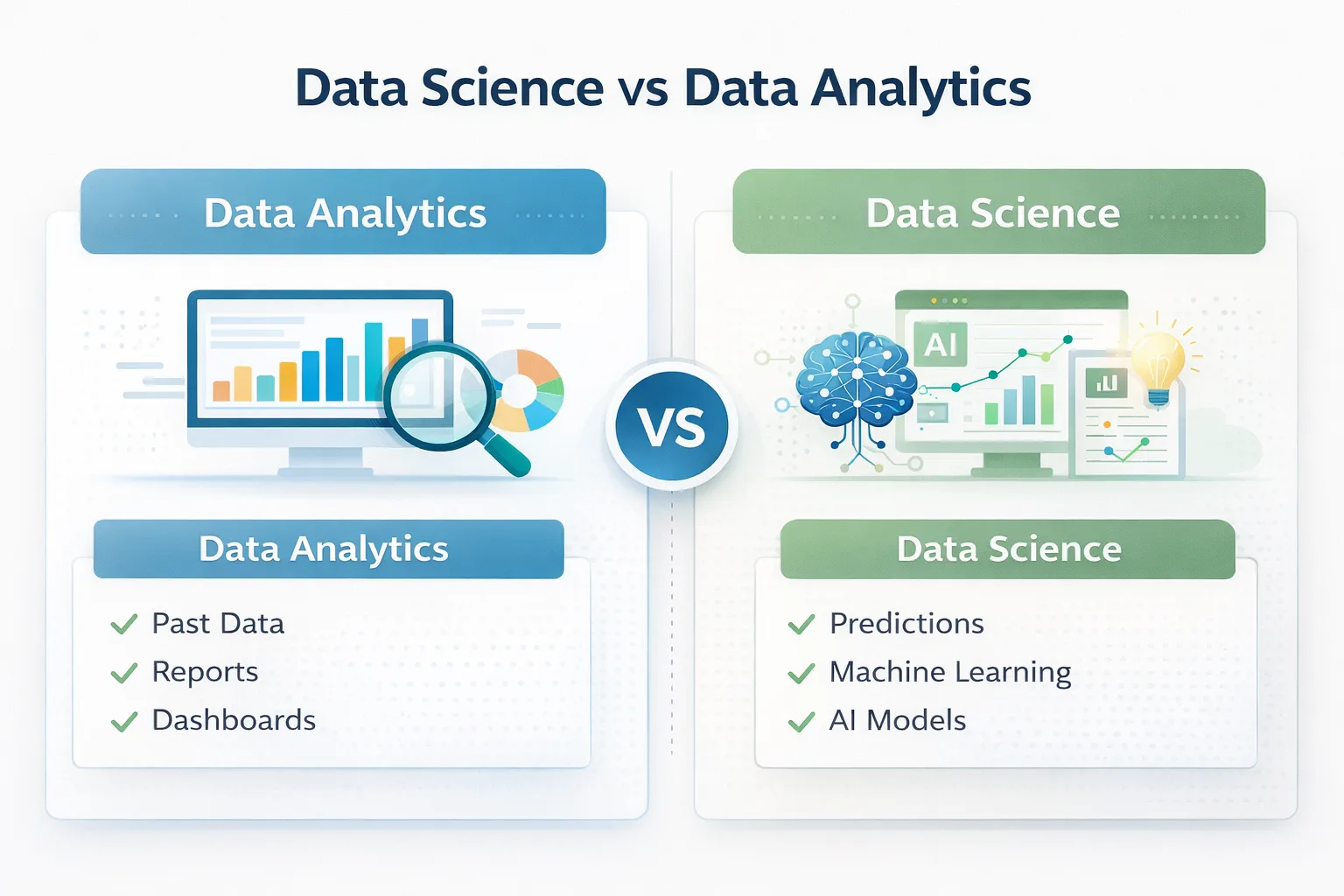
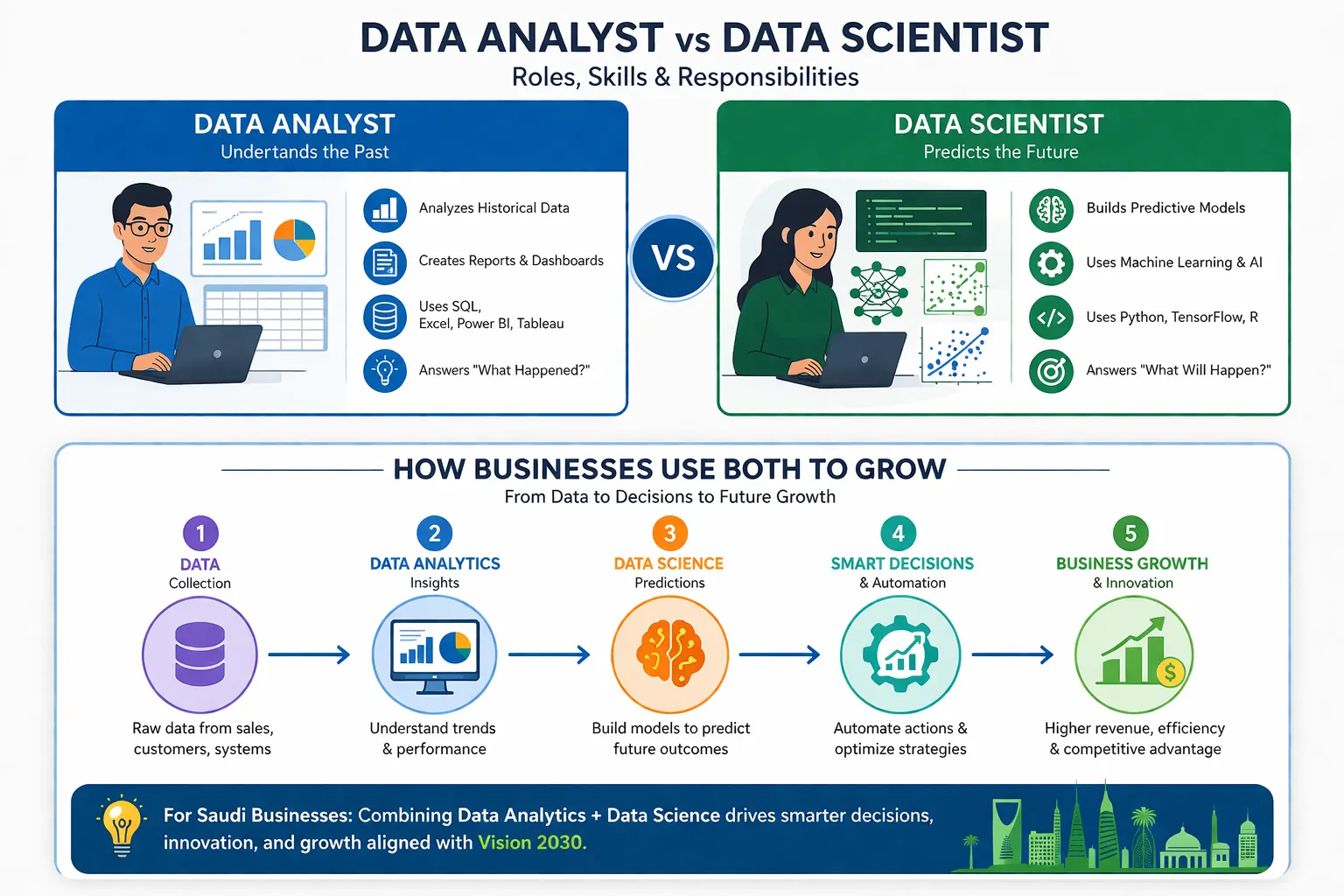
Data analytics is the practice of examining structured data—sales figures, customer records, operational metrics—to answer questions about what happened and why. Think of it as a high-powered magnifying glass pointed at your past and present performance.
A data analyst at a Saudi retail company might answer questions like “Which product categories underperformed in Q3?” or “Which Riyadh neighborhoods have the highest average order value?” They use tools like SQL, Excel, Power BI, and Tableau to clean data, build reports, and communicate findings to stakeholders.
The output is typically a dashboard, a report, or a presentation deck—something a non-technical manager can act on immediately. The value is clarity and speed: you make better decisions faster because you’re working with evidence, not intuition.
In Saudi Arabia, many companies use analytics for:
- Retail performance tracking
- Banking dashboards
- Customer behavior insights
Data analytics answers, “What happened?” and “Why did it happen?” — using historical data to drive decisions today.
What Is Data Science?
Data science goes further. It uses statistical modeling, machine learning, and artificial intelligence to answer questions about what is likely to happen next—and to build systems that automate decisions at scale.
A data scientist at a Saudi fintech company might build a credit-risk model that automatically scores loan applicants or develop a recommendation engine that personalises investment portfolios. They work with Python, R, TensorFlow, and cloud ML platforms like AWS SageMaker or Google Vertex AI.
The output is usually a model, an algorithm, or an automated pipeline — something that runs in the background and keeps getting better as it processes more data. The value is scale: once built, a well-tuned data science system can make millions of micro-decisions without human intervention.
Saudi industries adopting data science include:
- Fintech
- Healthcare
- Smart cities (NEOM)
- E-commerce
Data science answers, “What is likely to happen?” and “How can we automate decisions?” — using predictive models to drive future outcomes.
Data Science vs Data Analytics: Side-by-Side
| Dimension | Data Analytics | Data Science |
|---|---|---|
| Core question | What happened? Why? | What will happen? What should we do? |
| Time orientation | Retrospective/present | Predictive/prescriptive |
| Primary tools | SQL, Excel, Power BI, Tableau | Python, R, TensorFlow, Spark, cloud ML |
| Output | Dashboards, reports, KPIs | Predictive models, algorithms, automated pipelines |
| Skills required | Statistics, business acumen, data visualisation | Machine learning, software engineering, maths |
| Typical Saudi role | Business Analyst, BI Developer, Data Analyst | Data Scientist, ML Engineer, AI Researcher |
| Typical salary (KSA, 2024–25) | SAR 8,000–18,000/month | SAR 15,000–35,000/month |
Why This Distinction Matters for Saudi Businesses
Saudi Arabia is in a unique position. Vision 2030’s digital transformation agenda has pushed data onto the strategic agenda of virtually every organization—from ARAMCO’s operational intelligence projects to the Public Investment Fund’s portfolio analysis. The Saudi Data and Artificial Intelligence Authority (SDAIA) has made national AI capability a stated priority.
But enthusiasm often outpaces strategy. Many companies rush to hire data scientists before they even have clean, centralized data—like hiring a Formula 1 driver before you’ve built a car. If your data is scattered across spreadsheets, legacy ERP systems, and WhatsApp messages, a data analyst who can consolidate and make sense of that information will deliver ten times more value than a machine learning engineer who has nothing clean to train on.
“The biggest mistake I see Saudi companies make is hiring a data scientist when they actually need three good data analysts — and a reliable data pipeline.”
— MUHAMMED ARSHAD, Senior BI Consultant, Riyadh (2024)
On the other hand, organizations that have already built strong analytics foundations—solid dashboards, reliable KPIs, and clean databases—are often ready to move up the value chain into predictive modeling. At that point, bringing in data science talent is not just useful; it’s a competitive necessity, especially in sectors like banking, healthcare, and logistics.
The Data Maturity Ladder: Where Are You?
A useful framework for Saudi business leaders is the data maturity ladder. Most organizations find themselves positioned between two extremes.
Stage 1 — Descriptive (You need analytics)
You’re pulling reports manually, relying on gut feeling for major decisions, and your KPIs differ depending on who you ask. This is the most common stage among Saudi SMEs and mid-sized family businesses. The priority is building a data analyst function, cleaning your data, and creating a single source of truth.
Stage 2 — Diagnostic (You need better analytics)
You have dashboards, but you can’t always explain why numbers change. Root-cause analysis, cohort analysis, and funnel diagnostics are the tools of this stage. It would be beneficial to have senior analysts or data engineers at this stage, rather than data scientists.
Stage 3 — Predictive (You’re ready for data science)
You understand your business well from the data, and now you want to anticipate what comes next — customer churn, equipment failure, demand spikes. This is where machine learning models start earning their cost. You’re ready to invest in data science infrastructure and talent. See our guide on getting started with machine learning in Saudi Arabia →
Stage 4—Prescriptive / Automated (Advanced data science + AI)
Models are live in production, automating decisions and learning continuously. Very few Saudi companies are here today, but this is the target state for Vision 2030’s most ambitious digital enterprises — and the direction of travel across NEOM, STC, and Saudi Aramco’s digital ventures.
Hiring Guidance: Data Analyst vs Data Scientist in KSA
If you’re a hiring manager in Saudi Arabia, here’s a simple test: Can a human review every data-driven decision your team makes today? If yes, start with analytics. If the answer is, “We make thousands of microdecisions daily and can’t review them all,” you likely need data science.
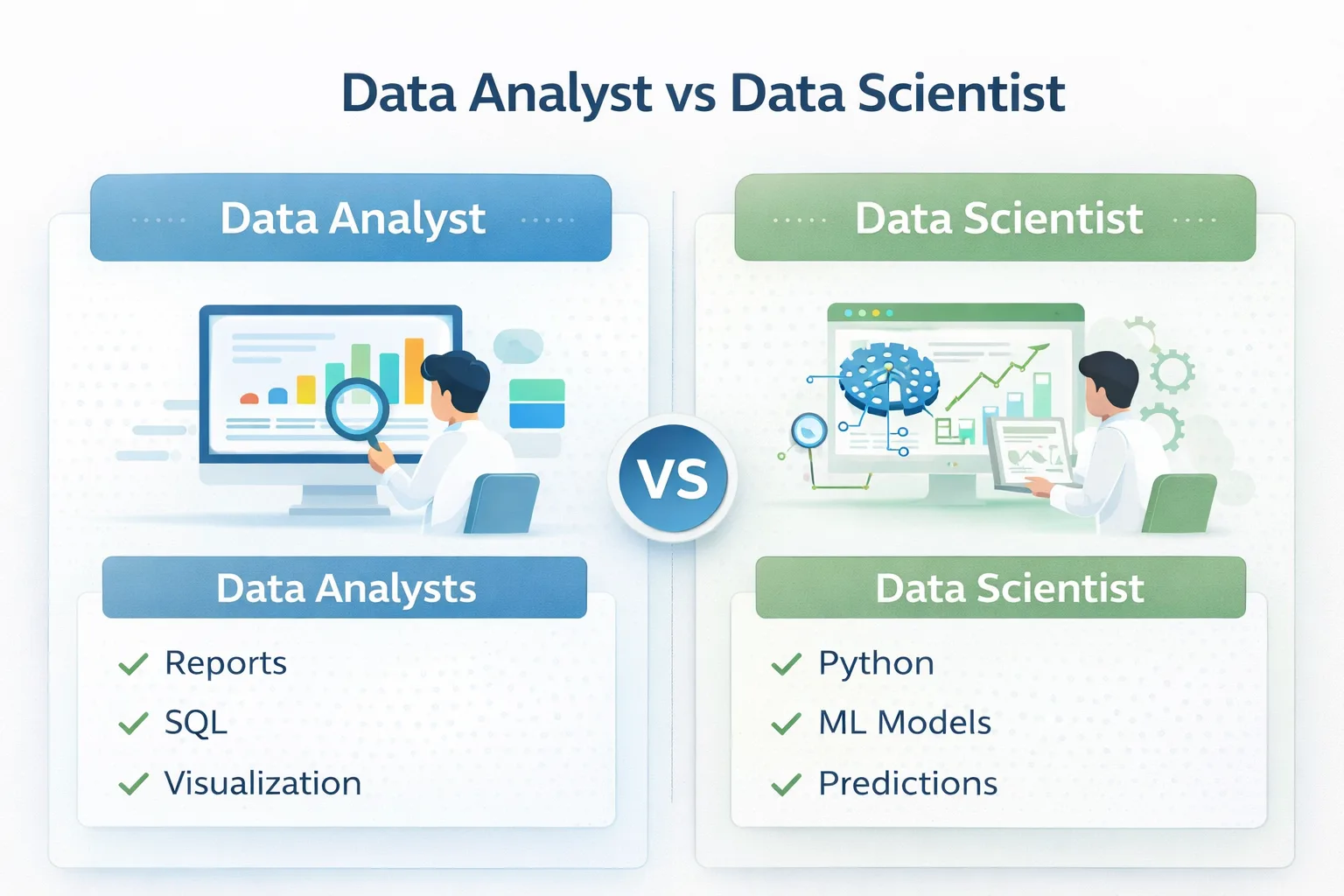
When hiring a data analyst in Saudi Arabia, look for proficiency in SQL and at least one BI tool (Power BI is dominant locally); a background in business or finance as much as statistics; and, crucially, the ability to communicate clearly in Arabic and English—because insights only create value when stakeholders actually understand and act on them.
When hiring a data scientist, look for a strong portfolio of deployed models (not just notebooks); experience with cloud ML platforms—AWS is widely used across the KSA enterprises; and a systems-thinking mindset. Someone who can work with an analytics engineer to ensure their models are fed clean, reliable data. Learn more in our complete guide to hiring data talent in Saudi Arabia →
For further benchmarking on data roles and salaries across the GCC, the Bayt.com salary reports and LinkedIn’s annual Jobs on the Rise data for MENA are both excellent references.
Future Trends in Saudi Arabia
The gap between analytics vs data science is shrinking.
Key trends include:
1. AI-Driven Analytics
Analytics tools are becoming smarter with built-in AI.
2. Cloud-Based Data Platforms
Companies are moving to AWS and Azure. Read: AWS Certification Salary Trends in UAE & Saudi
3. Hybrid Roles
Companies now want professionals who can do both:
- Data analysis
- Machine learning
Quick Recap: Which Does Your Business Need?
| Your situation | What you need |
|---|---|
| Data is siloed, no clear KPIs | Data Analyst + BI tools first |
| Good dashboards, want to understand why things happen | Senior Data Analyst / Analytics Engineer |
| Want to predict customer behaviour or automate decisions | Data Scientist + ML infrastructure |
| Building AI-native products or services | Full data science team + MLOps |
Whichever path you’re on, remember: data is only valuable when it leads to action. The best data teams — whether they’re analysts or scientists — are the ones closest to the business decisions that matter.
For a deeper dive into building data infrastructure, explore our related articles on data governance best practices in Saudi Arabia → and the best BI tools for GCC enterprises →
Frequently Asked Questions
What is the main difference between data science and data analytics?
Data analytics focuses on analyzing past data, while data science uses machine learning and algorithms to predict future outcomes.
Which is better: data analyst vs data scientist?
Both roles are important. Data analysts provide insights, while data scientists create predictive systems. Businesses need both for complete data strategy.
Is data science in demand in Saudi Arabia?
Yes. Data science is highly in demand due to AI adoption, fintech growth, and Vision 2030 digital initiatives.
Can a data analyst become a data scientist?
Yes. By learning programming (Python), machine learning, and statistics, analysts can transition into data science roles.
Which tools are used in data science vs analytics?
Data analytics uses tools like Power BI and Excel, while data science uses Python, TensorFlow, and advanced machine learning frameworks.
Conclusion
Understanding data science vs data analytics is no longer optional for businesses in Saudi Arabia—it’s essential.
Data analytics helps you understand your past.
Data science helps you build your future.
The most successful companies don’t choose one—they use both.
As Saudi Arabia continues its digital transformation, businesses that invest in the right data strategy will lead the next wave of innovation.