Quick Answer
The difference between generative AI vs AI (traditional artificial intelligence) is straightforward: traditional AI analyses, predicts, and automates tasks. Generative AI creates entirely new content — text, images, code, audio, and video. Generative AI is a subset of artificial intelligence, meaning all generative AI is AI, but not all AI is generative AI.
TL;DR
- Artificial Intelligence (AI) enables machines to mimic human intelligence across a wide range of tasks
- Generative AI is a specific subset of AI that creates entirely new content based on learned patterns
- Traditional AI focuses on prediction, classification, and automation
- Generative AI powers tools like ChatGPT, Gemini, Claude, and Midjourney
- GCC countries — particularly Saudi Arabia and UAE — are rapidly adopting both, but 73% of organisations that have piloted AI have yet to realise measurable value
- The gap is a skills and strategy problem, not a technology problem
If you’ve sat in a boardroom in Riyadh, attended a tech summit in Dubai, or scrolled through any business news in the GCC over the last two years, you’ve heard both terms — artificial intelligence and generative AI — used interchangeably, breathlessly, and often incorrectly.
They are not the same thing.
One is a broad field of technology that has existed for decades. The other is a powerful, specific category within that field that arrived at mainstream scale only recently and is now reshaping how businesses operate across every sector.
Getting this distinction right is not a trivial academic exercise. It matters for how you budget, how you hire, how you evaluate vendors, and how you build an AI strategy that actually delivers results in the GCC market.
This guide cuts through the confusion — with clear definitions, real examples, a proper breakdown of the types of AI, and specific relevance to what’s happening right now across Saudi Arabia, UAE, Bahrain, Qatar, and Kuwait.
What Is Artificial Intelligence?
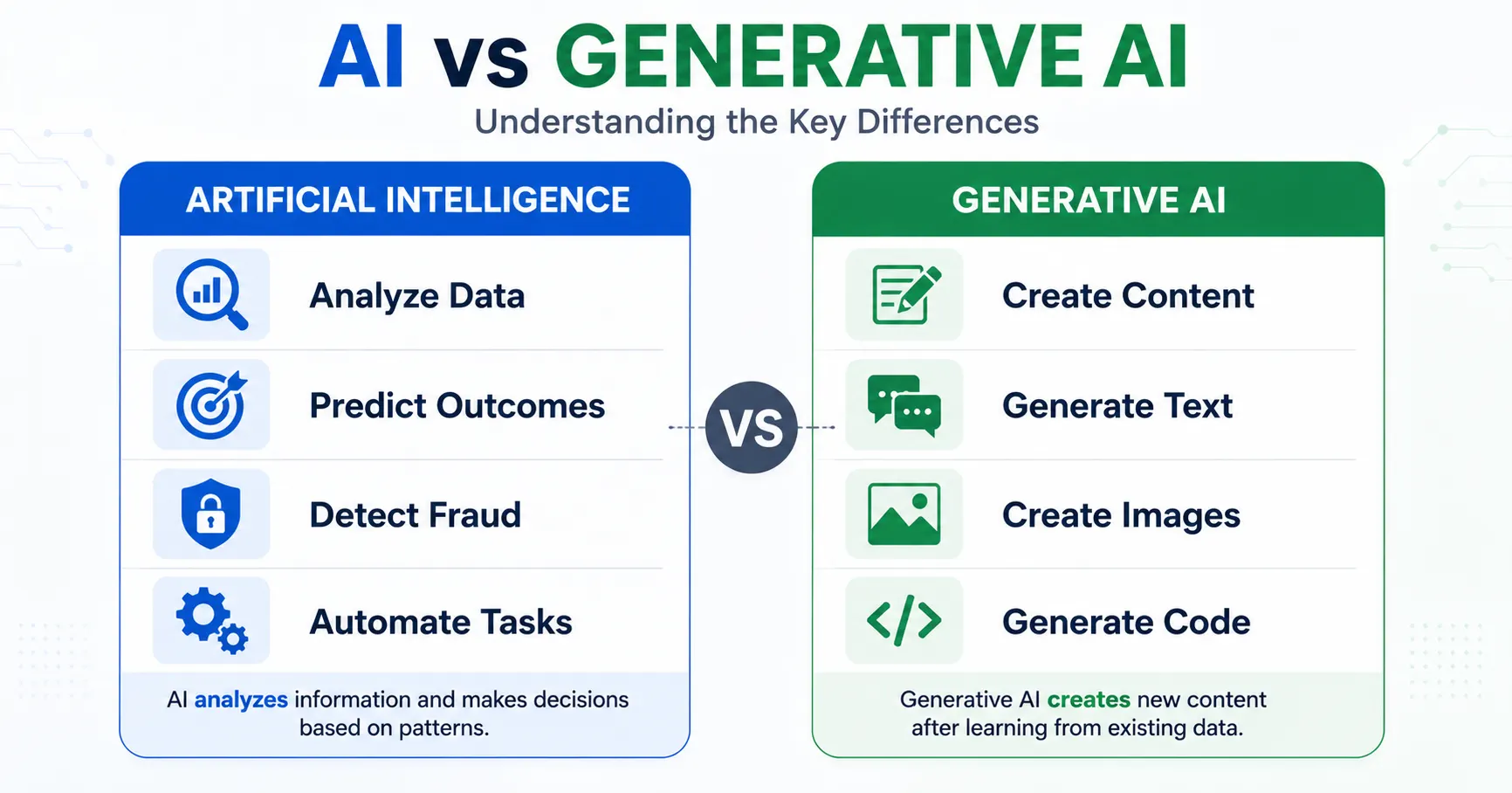
Artificial Intelligence (AI) refers to computer systems designed to perform tasks that typically require human intelligence.
These include problem-solving, decision-making, pattern recognition, speech recognition, and predictive analytics. If you’ve used fraud detection in banking, a recommendation engine on Netflix, or a navigation app that reroutes you around traffic, you’ve already experienced AI in action — long before ChatGPT was a household name.
Across the GCC, AI adoption has been accelerating rapidly. Saudi Arabia’s Vision 2030 and the UAE National AI Strategy are major drivers behind this growth, embedding AI into smart city infrastructure, healthcare modernisation, financial services, and digital government services. According to a 2025 McKinsey survey of 139 senior executives across GCC organisations, 62% had already adopted AI in at least one core business function.
Types of Artificial Intelligence
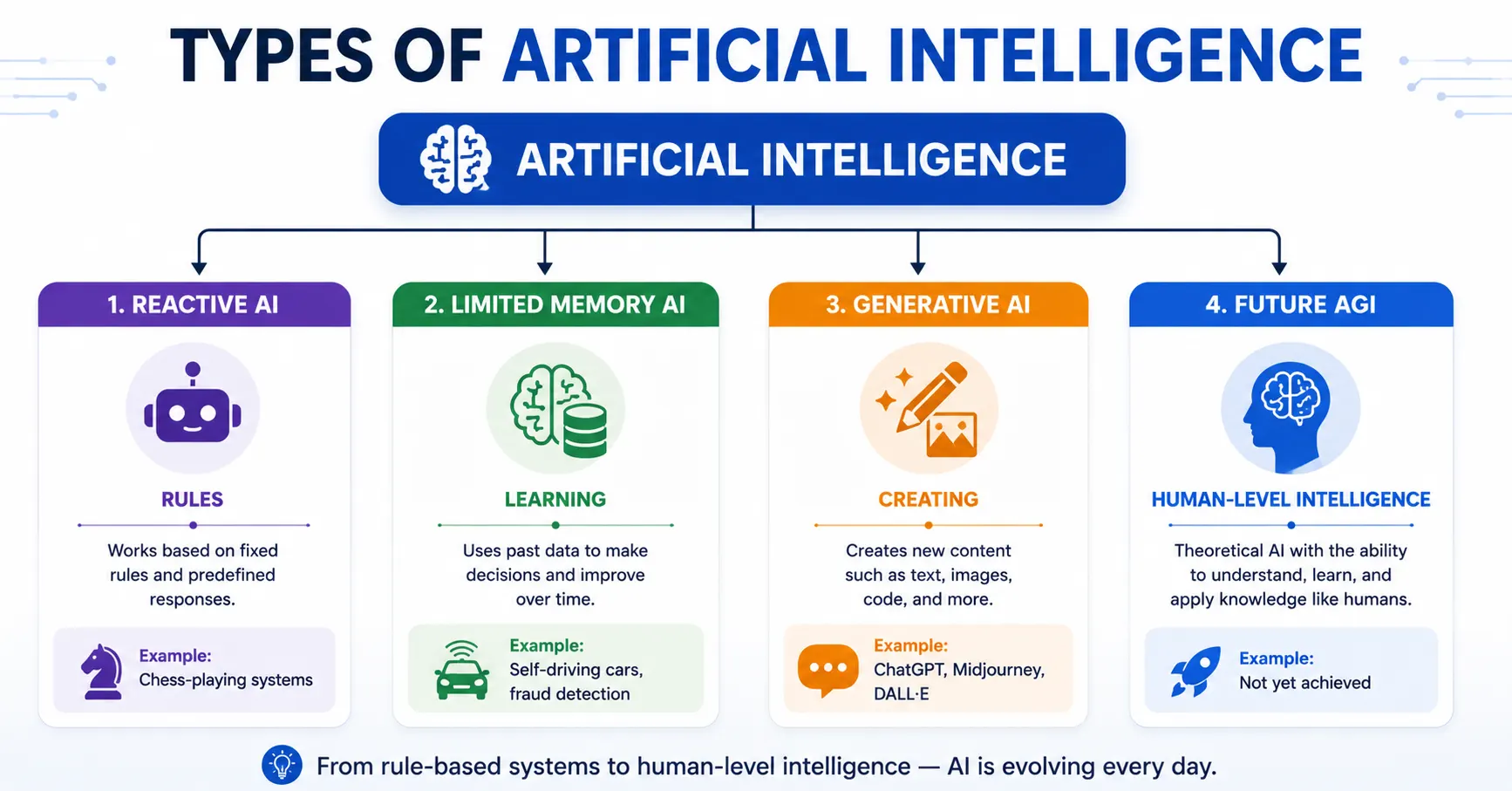
Understanding the types of artificial intelligence helps clarify exactly where generative AI fits — and why the distinction matters for business decisions.
By Capability Level
Narrow AI (Artificial Narrow Intelligence — ANI)
All real-world AI that exists and works today is Narrow AI. It is designed to do one specific thing, and it does that one thing exceptionally well — often better than any human. Fraud detection, medical imaging analysis, GPS routing, facial recognition at UAE airports, spam filters, and voice assistants are all examples. Even ChatGPT, despite feeling remarkably general, is technically Narrow AI — it generates text, but cannot reason across unfamiliar domains the way a human can.
General AI (Artificial General Intelligence — AGI)
A hypothetical AI system that can learn, reason, and apply intelligence flexibly across any domain — the way humans do. AGI does not exist yet. It is the subject of intense research, significant investment, and genuine debate about both its feasibility and timeline. For any practical business conversation in 2026, AGI is not on the table.
Superintelligence (Artificial Superintelligence — ASI)
Entirely theoretical — an AI that surpasses human intelligence across every domain: creativity, reasoning, scientific discovery, emotional understanding. This remains firmly in the realm of long-term risk research and philosophy.
By Function
Reactive Machines
The most basic type. These systems respond to specific inputs with predetermined outputs and have no memory. IBM’s Deep Blue chess computer is the classic example: brilliant at chess, incapable of anything else.
Limited Memory AI
The most common type in use today. These systems learn from historical data to improve decisions over time. Most machine learning models, including self-driving car systems and recommendation engines, fall here.
Theory of Mind AI
A future category. These systems would understand human emotions, beliefs, and social context. Research is active; production systems do not yet exist.
Self-Aware AI
entirely theoretical. A self-aware AI would have its own consciousness. This belongs to philosophy as much as computer science.
What Is Generative AI?
Generative AI is a subset of artificial intelligence specifically designed to generate original content — rather than analyse or classify existing information.
Instead of simply reading data and producing a decision, generative AI learns patterns from training data and then produces something entirely new:
- Articles, reports, and emails
- Images and visual campaigns
- Software code
- Audio and video content
- Synthetic data for research
This is why generative AI has become one of the most disruptive technologies in recent business history. A marketing manager in Riyadh can now produce an entire campaign brief in minutes. A bank in Dubai can generate personalised customer communication drafts at scale. An engineer in Abu Dhabi can query decades of operational data and receive a plain-English summary — instantly.
That’s the power of generative AI. And it sits within the broader family of AI, not separate from it.
Generative AI vs AI: The Core Distinction
The simplest way to hold this distinction in your head:
AI tells you what might happen. Generative AI creates something new.
Here’s how they compare across the dimensions that matter most for business decisions:
| Dimension | Traditional AI | Generative AI |
|---|---|---|
| Core purpose | Analyse, classify, predict, decide | Create new content |
| Output type | Labels, scores, decisions, alerts | Text, images, code, audio, video |
| Business use | Automation, analytics, risk management | Content generation, summarisation, communication |
| Data approach | Structured, labelled datasets | Massive unstructured training corpora |
| Key architectures | Decision trees, CNNs, SVMs, RNNs | Transformers, GANs, diffusion models |
| Leading examples | Fraud detection, medical imaging, GPS routing | ChatGPT, Gemini, Claude, Midjourney, DALL·E |
| GCC adoption | Deeply embedded in banking, energy, logistics | Rapidly scaling in content, services, reporting |
| Skills needed | Data science, ML engineering, statistics | Prompt engineering, LLM fine-tuning, AI governance |
| Primary risks | Bias, accuracy, black-box decisions | Hallucination, privacy, copyright, over-reliance |
The most important line in that table: generative AI is not replacing traditional AI. It complements it. Both serve fundamentally different business purposes. The most sophisticated AI deployments in the GCC right now use both working in tandem — traditional AI for precision and speed, generative AI for communication and creation.
How Generative AI Works
Machine Learning and Training Data
Generative AI models are trained on enormous datasets — billions of pages of text, millions of images, vast repositories of code. During training, the model learns statistical patterns: which words tend to follow which other words, what visual features make an image coherent, what code structures produce working programs. Once trained, the model generates new content by applying those learned patterns to any prompt it receives.
Large Language Models (LLMs)
The most prominent generative AI systems — ChatGPT, Claude, Gemini — are Large Language Models. They are trained on text data and generate language-based outputs by predicting what should come next in a sequence, given context and learned patterns. They do not “understand” language the way humans do. They are extraordinarily sophisticated pattern-completion systems. But the outputs they produce can be indistinguishable from human writing, and in many cases faster and more consistently structured.
Deep Learning and Neural Networks
Generative AI is powered by deep learning — multi-layered neural networks that process data in a way loosely inspired by the human brain. The depth and breadth of these networks is what allows generative models to handle the complexity of language, visual content, and code simultaneously.
Transformers and Diffusion Models
The transformer architecture — introduced in 2017 — is what made modern LLMs possible. It processes entire sequences of data simultaneously, which made training on internet-scale datasets feasible. For image generation, diffusion models (used by Midjourney and DALL·E) start from pure noise and iteratively refine toward a coherent image. Understanding the basics of these architectures helps you ask better questions of AI vendors and evaluate claims more critically.
Generative AI Examples in Real Life
Most people use generative AI daily without fully realising it. Here are the categories most relevant to GCC business contexts.
AI Chatbots and Conversational AI
ChatGPT (OpenAI), Gemini (Google), and Claude (Anthropic) are the leading text-based generative AI tools — used for customer service, research, content drafting, and coding assistance. GCC businesses are deploying customised versions of these for Arabic-language customer support, internal knowledge bases, and HR communications.
AI Image Generation
Midjourney and DALL·E generate photorealistic images, stylised artwork, and branded visuals from text descriptions. Marketing agencies in Dubai and Riyadh are using these to generate Ramadan campaign visuals, architectural renderings, and social content without full production shoots.
AI Coding Tools
GitHub Copilot and similar tools autocomplete code, suggest functions, flag bugs, and generate test scripts. Developers using AI coding assistants report 30–55% faster completion on routine tasks — a meaningful productivity gain for tech teams across the GCC.
AI Content Creation
Blog articles, social media posts, product descriptions, email campaigns, financial reports — generative AI can produce drafts of all of these at scale. The key is using human editors to maintain quality and brand voice, not removing them from the process entirely.
Generative AI Applications Across GCC Industries
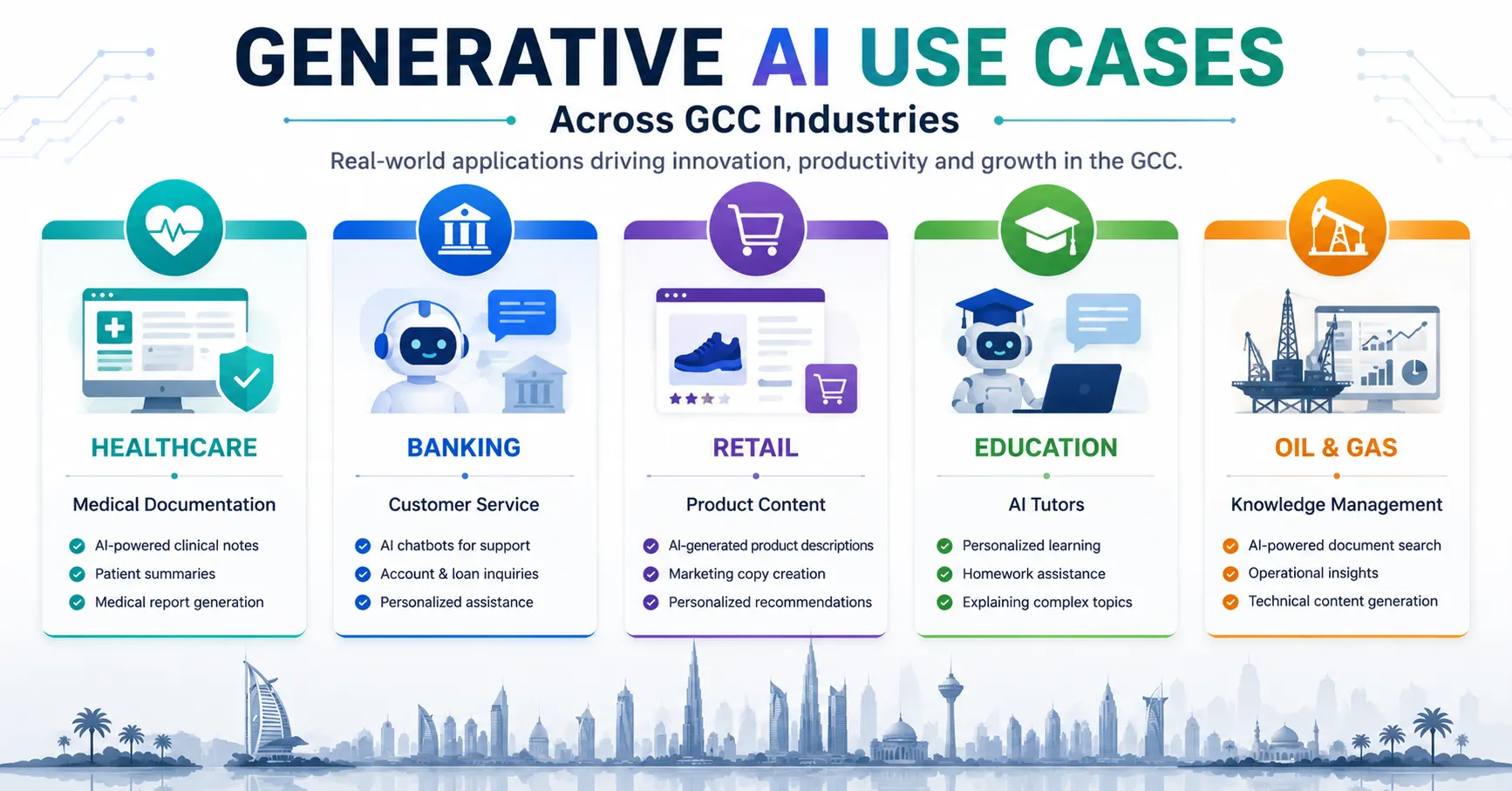
This is where many comparison articles stop. Here’s how businesses in the Gulf are actually using both types of AI — and why both matter.
Banking and Financial Services
Traditional AI in banking: Fraud detection algorithms that analyse thousands of transactions per second, credit scoring models that assess loan applications, and algorithmic trading systems that execute positions based on market signals. These are classification and prediction tasks — Narrow AI at its most precise.
Generative AI in banking: Customer support chatbots that handle complex queries in Arabic and English, AI tools that draft compliance reports and summarise regulatory changes, and systems that generate personalised client communications at scale. Saudi and UAE banks are investing heavily in both.
The AI in Saudi Arabia financial sector is evolving rapidly — and understanding the difference between the two types of AI is essential for evaluating vendor proposals intelligently. For Shariah-compliant banking specifically, read our piece on AI in Islamic Finance: use cases transforming the Middle East.
Healthcare
Traditional AI in healthcare: Diagnostic imaging models that detect tumours, diabetic retinopathy, and fractures with accuracy that matches or exceeds radiologists. Predictive models that flag patients at risk of deterioration before clinical signs are obvious.
Generative AI in healthcare: AI that transcribes and structures clinical consultations, generates draft discharge summaries, synthesises patient histories from fragmented records, and assists drug discovery by generating candidate molecular structures. Healthcare providers across UAE and Saudi Arabia are exploring generative AI specifically to reduce the administrative burden on clinical staff.
Read more in our piece on data science in healthcare: transforming the Middle East.
Retail and E-Commerce
Traditional AI in retail: Recommendation engines that personalise product feeds based on browsing behaviour, inventory forecasting models, and dynamic pricing algorithms.
Generative AI in retail: AI-generated product descriptions in multiple languages, personalised marketing campaign copy, and customer engagement chatbots that handle queries and returns around the clock. The combination of both — traditional AI for what to show, generative AI for how to say it — is where GCC retailers are finding the most value.
Oil, Gas, and Energy
This is one of the most significant GCC generative AI opportunities, and one of the least discussed in global AI content — making it a genuine SERP gap for regional audiences.
Traditional AI in energy: Predictive maintenance models that forecast equipment failure from sensor data, seismic interpretation algorithms, and energy demand forecasting for grid management.
Generative AI in energy: AI that generates human-readable reports from terabytes of drilling and operational data — exactly what Saudi Aramco has demonstrated with its internal generative AI model trained on 250 billion parameters and decades of operational history. Knowledge management systems that make institutional expertise searchable by engineers who weren’t there when the experience was first accumulated.
Government and Public Services
Traditional AI in government: Smart city systems optimising traffic and public transport, document classification for government records, and public safety analytics.
Generative AI in government: AI drafting citizen communications, translating policy documents into accessible Arabic, generating ministerial briefing notes from structured data, and powering next-generation e-government service chatbots. Qatar’s government signed a five-year partnership with Scale AI in 2025 specifically to accelerate AI adoption across public services.
Education and Professional Development
Traditional AI in education: Adaptive learning platforms that adjust difficulty based on student performance, automated grading, and plagiarism detection.
Generative AI in education: AI tutors that explain concepts multiple ways until a student understands, tools that generate personalised practice questions and assessments, and platforms that localise educational content into Arabic. For GCC professionals building AI skills, our Generative AI for Finance course and Generative AI in Sales certification are specifically designed for working professionals in the region.
When to Use Traditional AI vs Generative AI
One of the most practical questions for any GCC business leader evaluating AI tools is: which type of AI do I actually need here?
Reach for traditional (narrow) AI when:
- You need to classify, detect, or predict at high volume and speed
- The output is a decision, a score, or a label — not prose or an image
- Consistency and accuracy are paramount and creative variation is a risk
- You are working with structured, tabular data
Reach for generative AI when:
- You need to produce written, visual, or coded output at scale
- You are accelerating a task that currently requires a human to read, interpret, and write
- You want to make complex information accessible to a non-specialist audience
- You need first drafts, summaries, translations, or creative variations
Use both together when:
- A traditional AI flags a fraud anomaly, and generative AI explains it in plain English for the compliance team
- A predictive model identifies high-risk patients, and generative AI summarises their history for the clinical team
- A recommendation engine surfaces the right product, and generative AI writes the personalised message around it
The most sophisticated AI deployments across the GCC right now use both working in tandem — traditional AI for precision, generative AI for communication.
Benefits of Generative AI
Faster Content Creation
Tasks that once took hours now take minutes. A marketing brief, a client report, a product description in Arabic and English — generative AI produces solid first drafts that human editors can refine, rather than human writers starting from nothing.
Increased Productivity
Employees spend less time on repetitive, document-heavy cognitive work and more time on decisions and relationships that require genuine human judgement. IBM’s 2026 EMEA study found 77% of UAE senior leaders reported significant productivity improvements from AI deployment — well above the global average.
Better Customer Experience
AI-powered interactions are available 24/7, respond in multiple languages, and can handle complex queries without wait times. For GCC businesses operating across Arabic and English markets, this is a genuine competitive advantage.
Improved Innovation
Teams can rapidly prototype ideas, generate content variants, and explore creative directions that would have been too time-intensive to attempt manually. Generative AI lowers the cost of experimentation.
Cost Savings
Automation reduces operational overhead across content, communications, reporting, and customer service functions — freeing budget for higher-value activities.
Challenges and Risks: The Honest Assessment
Generative AI is powerful. It is not perfect. The organisations using it most successfully are the ones who went in with clear eyes about its limitations.
Hallucination and Accuracy
Generative AI can produce confident-sounding output that is factually incorrect. This is a structural characteristic of probabilistic generation — not a bug that will be fully patched. Human review is not optional; it is essential, especially in regulated domains like healthcare, legal, and finance.
Data Privacy and Security
Feeding sensitive business data into third-party generative AI systems raises genuine data governance questions. Understanding where data goes, how it is stored, and whether it is used to train future models is a non-negotiable first step for enterprise deployments. Our cybersecurity fundamental certification covers the governance frameworks GCC organisations need.
Bias in Outputs
AI models learn from their training data — and if that data reflects historical biases, the model will reproduce them. This requires ongoing monitoring, particularly for customer-facing applications.
Copyright and Ethics
The legal landscape around AI-generated content — who owns it, what constitutes infringement — remains unsettled in most jurisdictions, including across the GCC. Organisations need clear internal policies now, not after a dispute arises.
Human Oversight is Non-Negotiable
The most successful organisations use AI as an assistant — not a replacement. Removing human review from generative AI workflows creates reputational and compliance exposure. The technology is a lever, not a substitute for expert judgement.
The GCC Reality: High Pilots, Low Value — and What Fixes It
Here is a data point that should be front of mind for every business leader in the region.
According to McKinsey, 73% of GCC organisations had piloted generative AI applications — but only 11% had realised measurable value. The primary blockers were identified as talent shortages and data governance challenges, not technology limitations.
Separately, a 2025 workforce survey found that 74% of UAE respondents and 68% of Saudi respondents reported using generative AI weekly — but 61% said their employers provided insufficient training. That is the highest AI anxiety score of any high-income region globally.
The gap is a skills and strategy problem. The organisations closing it are those investing in structured capability building — not just tool access.
For professionals building genuine AI capability, our Data Science with Python certification and AI Engineering Professional Certification build the practical skills that go beyond surface-level tool use. For teams, our corporate training programmes are designed for GCC business contexts specifically.
The Future: Where AI and Generative AI Are Heading
The most interesting near-term development is not generative AI versus traditional AI. It is their convergence.
Agentic AI — systems that can plan, take sequential actions, and complete multi-step business processes with minimal human oversight — is the next major wave. It combines the precision of traditional AI with the language fluency of generative AI. IBM’s 2026 EMEA study found 92% of GCC senior leaders expected agentic AI to deliver measurable ROI within two years.
Multimodal AI — models that simultaneously process and generate text, images, audio, and video — is collapsing previous category boundaries. Gemini and GPT-4o are already multimodal; future models will be more capable across more domains.
Sovereign AI — a concept particularly relevant to the GCC — refers to countries developing their own AI infrastructure, models, and data governance frameworks rather than depending entirely on US or Chinese technology. Saudi Arabia’s HUMAIN, Abu Dhabi’s G42, and Qatar’s Digital Agenda 2030 investments all reflect this direction. For GCC businesses, this means Arabic-language, locally compliant AI solutions are becoming increasingly available — reducing the historical dependency on global tools that weren’t built for the region’s linguistic and cultural context.
The organisations that understand the full AI landscape — not just the generative AI layer — will be best positioned to navigate these shifts intelligently.
Conclusion
The debate around generative AI vs AI isn’t about choosing one over the other. Generative AI is the most powerful and visible evolution of artificial intelligence — but it sits within a much broader field, and that field still matters enormously.
Traditional AI helps organisations analyse, automate, and decide with precision. Generative AI helps them create, communicate, and scale with speed. For GCC businesses navigating digital transformation, understanding both technologies — and how they work together — is becoming a competitive necessity rather than a technical curiosity.
The companies that learn, distinguish, and deploy both intelligently today will lead tomorrow’s economy across the Gulf.
Whether you’re looking to upskill your team with AI and ML courses, explore IT consulting services to shape your AI strategy, or find IT staffing solutions to bring the right AI talent in-house — the infrastructure to get started is right here.
Frequently Asked Questions
What is the difference between AI and generative AI?
Artificial intelligence is the broad field of computer science focused on building machines that can perform tasks requiring human intelligence — including classification, prediction, and decision-making. Generative AI is a specific subset focused on creating new content: text, images, video, audio, and code. All generative AI is AI, but the vast majority of AI in use today is not generative AI.
Is ChatGPT an example of generative AI?
Yes. ChatGPT is one of the most widely used examples of generative AI. It is built on GPT (Generative Pre-trained Transformer) Large Language Models developed by OpenAI and generates human-like responses based on text prompts. It is technically a form of Narrow AI, even though its capabilities feel impressively broad.
Is generative AI replacing traditional AI?
No. Generative AI complements traditional AI rather than replacing it. Traditional AI excels at classification, prediction, and high-speed decision-making on structured data. Generative AI excels at content creation, summarisation, and communication. The most effective enterprise AI deployments combine both — traditional AI for precision, generative AI for communication.
What are the main types of artificial intelligence?
By capability level: Narrow AI (all real-world AI today), General AI (hypothetical, human-level across all domains), and Superintelligence (theoretical, beyond human intelligence). By function: Reactive Machines, Limited Memory AI (the most common today), Theory of Mind AI (future), and Self-Aware AI (theoretical).
What industries use generative AI in the GCC?
Healthcare (clinical documentation, patient communication), banking and finance (compliance reporting, customer service, Arabic-language chatbots), oil and gas (operational report generation, knowledge management), government (citizen services, policy communication), retail (product content, personalised campaigns), and education (AI tutors, Arabic content localisation) are all actively deploying generative AI across the Gulf.
Why are only 11% of GCC organisations realising value from AI?
According to McKinsey research, the main barriers are talent shortages and data governance challenges — not technology availability. Most organisations have run pilots without building the internal capability, data infrastructure, or governance frameworks required to scale AI into production. Closing this gap requires structured training, clear use-case prioritisation, and often expert implementation support.
What is the difference between generative AI and AGI?
Generative AI refers to current systems that create content based on learned patterns — a form of Narrow AI, highly capable within their domain. AGI (Artificial General Intelligence) is a theoretical future system capable of human-level intelligence across any task or domain. No AGI exists today. Generative AI, impressive as it is, is not AGI.