Let’s Be Honest — Why Everyone’s Talking About Data Science Right Now
A few months ago, we spoke to a hiring manager in Dubai.
He told us something that stuck:
“We’re not struggling to find candidates. We’re struggling to find people who can actually solve problems.”
That’s the gap.
Everyone is learning data science.
Very few are becoming data scientists.
And in the GCC right now?
That gap is an opportunity.
Saudi Arabia, UAE, Qatar — they’re not just adopting AI…
They’re building entire economies around it.
How to become a data scientist is one of the most searched career questions across the GCC right now — and for good reason. Saudi Arabia’s Vision 2030, the UAE’s National AI Strategy, and Qatar’s push toward a digital economy have collectively created one of the most data-hungry job markets in the world. If you are a student, a professional looking to pivot, or an employer trying to understand what skills your team needs, this guide provides a complete, honest roadmap for 2026.
What Does a Data Scientist Do?
Forget the textbook definition for a second.
A data scientist is someone who answers questions like:
- “Which customers are about to leave?”
- “Why are sales dropping in Riyadh but rising in Dubai?”
- “Can we predict equipment failure before it happens?”
What Are the Key Roles and Responsibilities of a Data Scientist?
Day-to-day, data scientists work across three core activities:
- Data collection and cleaning — sourcing structured and unstructured data from databases, APIs, and sensors, then resolving inconsistencies, missing values, and formatting errors. In practice, this consumes 60–80% of a data scientist’s time.
- Building machine learning models — designing, training, and validating algorithms that identify patterns, make predictions, or automate decisions.
- Data visualisation and reporting — translating model outputs into dashboards, charts, and narratives that non-technical stakeholders can act on.
See real-world use cases → Data Science in Healthcare: Transforming Healthcare in the Middle East
Why Is Data Science in High Demand in 2026?
Globally, the World Economic Forum’s Future of Jobs Report consistently ranks data and AI roles among the fastest-growing occupations. In the GCC specifically, demand has been amplified by policy. Saudi Arabia’s Vision 2030 has earmarked significant investment in AI and digital infrastructure. The UAE’s AI Strategy 2031 targets 25% of government services to be AI-driven. Qatar, Bahrain, and Kuwait are running parallel digital transformation programmes.
The result: thousands of data science roles advertised across the Gulf — and not enough qualified candidates to fill them.
What Are the Data Science Skills Required in 2026?
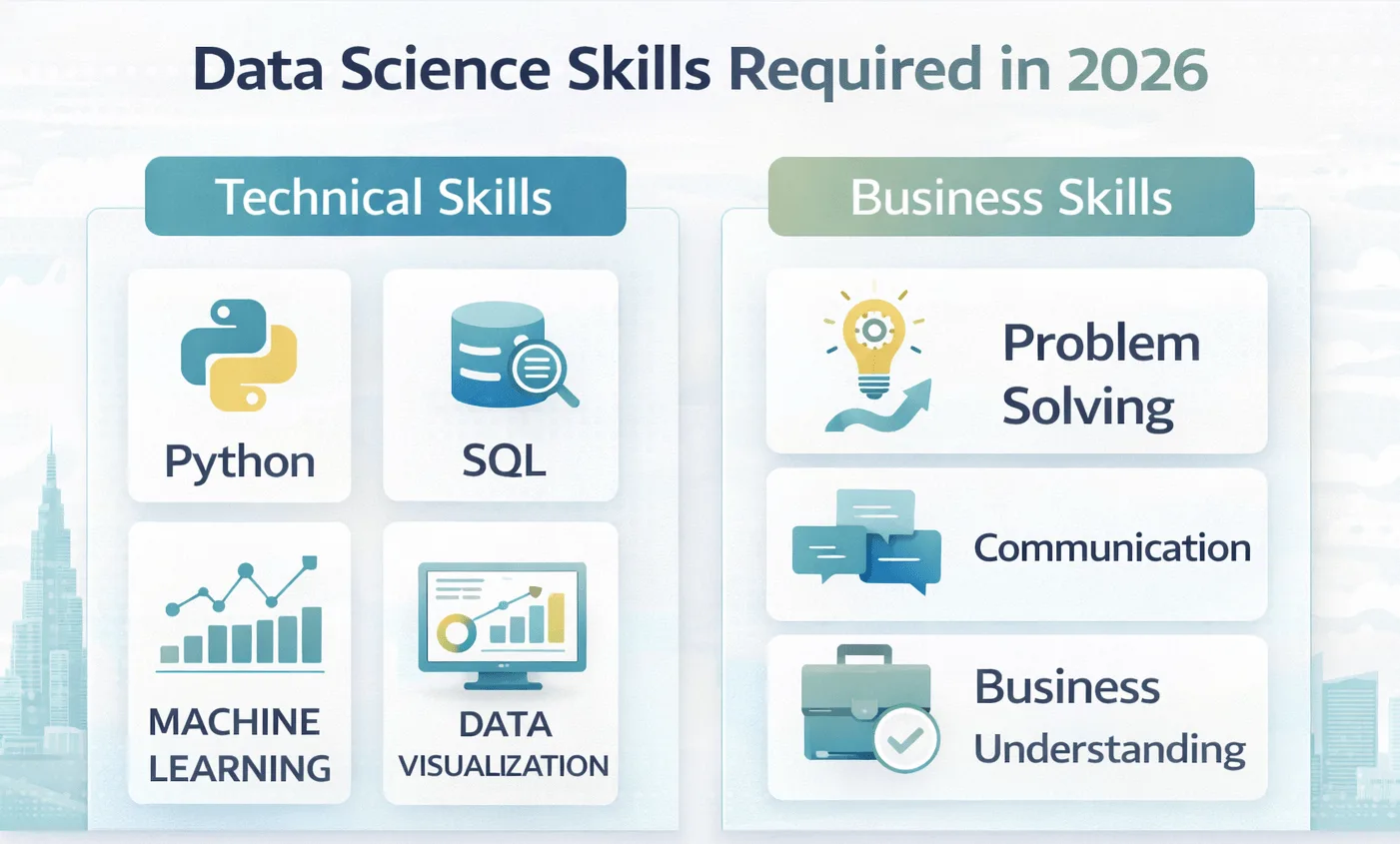
Data science skills required in 2026 span both technical and human capabilities. Employers in the GCC, particularly in finance, healthcare, and energy, increasingly screen for both — and candidates who have only one side of the equation struggle to progress.
Technical Skills Every Data Scientist Needs
| Skill | Tool / Language | Why It Matters |
|---|---|---|
| Programming | Python (primary), R (statistical work) | Core language for data manipulation, ML, and automation |
| Database querying | SQL | Essential for extracting data from relational databases |
| Machine learning | Scikit-learn, TensorFlow, PyTorch | Building and deploying predictive models |
| Data visualisation | Power BI, Tableau, Matplotlib | Communicating findings to business stakeholders |
| Cloud platforms | AWS, Azure, Google Cloud | Most GCC enterprise data infrastructure is cloud-based |
| Version control | Git / GitHub | Required for collaborative, production-grade data science |
Non-Technical Skills That Separate Good from Great
Technical fluency gets you an interview. These skills get you hired — and promoted:
Problem framing — the ability to translate a business question (“why are our customer churn rates rising?”) into a data question with measurable outcomes. Many beginners skip this and build impressive models that answer the wrong question.
Business understanding — domain knowledge of the industry you work in. A data scientist in UAE banking who understands Basel III capital requirements is worth more than one who does not.
Communication — the ability to present complex findings to a CFO, a clinical director, or a government official without losing the insight in technical jargon. This is non-negotiable in GCC workplaces where decisions are made at the senior level.
Deep dive tools → Top Data Science Tools Used by Companies in 2026
What Is the Step-by-Step Data Scientist Roadmap for 2026?
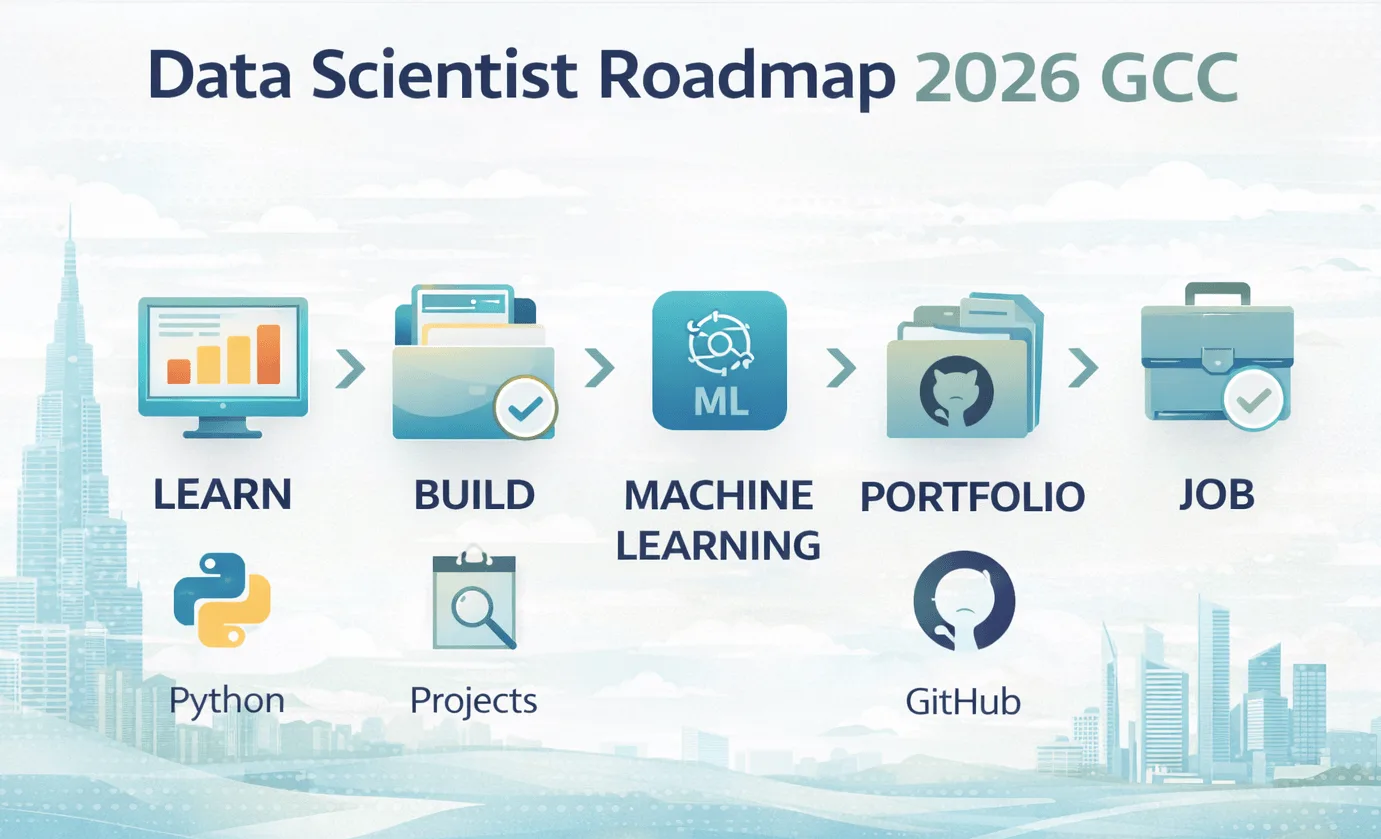
This data scientist roadmap is structured for someone starting from zero. If you already have some programming or statistics background, you can enter at the relevant step.
Step 1 – Learn the Fundamentals: Statistics and Probability
Everything in data science rests on statistical thinking. Begin with descriptive statistics (mean, median, variance), probability distributions, hypothesis testing, and correlation. Allocate 4–6 weeks here.
Step 2 – Learn Python (Recommended for GCC Job Market)
Python is the dominant language in GCC data science job postings. Start with core syntax, then move to NumPy and Pandas for data handling, and Matplotlib or Seaborn for visualisation. Most learners reach functional proficiency in 8–12 weeks of consistent daily practice.
Step 3 – Work on Real Data Science Projects
Theory without application creates unemployable data scientists. From week one, work with real datasets — Kaggle, UCI Machine Learning Repository, and UAE Open Data Portal all offer free datasets. Analyse something you find genuinely interesting: UAE traffic patterns, GCC commodity prices, hospital admission data.
Step 4 – Learn Machine Learning
Once you can handle data fluently in Python, begin machine learning with supervised algorithms (linear regression, decision trees, random forests), then unsupervised methods (clustering, dimensionality reduction).
Step 5 – Build a Portfolio on GitHub
Employers in the GCC — especially in tech and consulting — screen GitHub profiles as seriously as CVs. Aim for three to five projects that demonstrate breadth: one regression problem, one classification problem, one visualisation project, and ideally one with a GCC-relevant dataset. Document your work clearly. Explain your thinking, not just your code.
Step 6 – Apply for Jobs and Internships
With a portfolio in hand, begin applications. In the UAE, LinkedIn, Bayt, and NaukriGulf carry the highest volume of data science roles. In Saudi Arabia, Jadarat and LinkedIn dominate. Tailor each application to the industry’s data problems, not just the job description’s keyword list.
What Are the Best Data Science Courses in GCC (UAE, Saudi Arabia, Qatar)?
Data science courses in the GCC range from globally recognised online programmes to in-person corporate training with regionally relevant curriculum.
Top Online Courses for GCC Learners
| Platform | Course | Best For |
|---|---|---|
| Coursera | IBM Data Science Professional Certificate | Complete beginners |
| Coursera | Google Advanced Data Analytics | Career switchers with some background |
| edX | MIT MicroMasters in Statistics and Data Science | Rigorous academic grounding |
| Udemy | Python Bootcamp (Jose Portilla) | Fast, practical Python foundation |
| Unique System Skills | Data Scientist Career Track | Structured, skills-first progression |
Classroom and Corporate Training in GCC
In the UAE, institutions, including KHDA-regulated training providers in Dubai Knowledge Park offer instructor-led data science bootcamps. Abu Dhabi’s Hub71 ecosystem regularly runs AI upskilling cohorts for startups and scaleups.
In Saudi Arabia, the Human Capability Development Programme (under Vision 2030) subsidises data and AI training through approved providers. The Saudi Digital Academy has trained thousands of Saudi nationals in data science and machine learning since 2021.
In Qatar, the Qatar Science and Technology Park (QSTP) and Hamad Bin Khalifa University offer graduate-level data science programmes with strong industry placement networks.
What Are the Top Data Science Certifications in UAE and GCC?
Data science certification in the UAE and across the GCC carries real weight with employers — particularly globally recognised credentials that signal verifiable, tested competence.
Globally Recognised Certifications
- Google Data Analytics Professional Certificate — widely recognised, strong on SQL and visualisation, accessible to beginners
- IBM Data Science Professional Certificate — covers the full stack from Python to machine learning to deployment
- Microsoft Certified: Azure Data Scientist Associate — highly valued in GCC enterprises running Microsoft infrastructure
- AWS Certified Machine Learning – Specialty — growing demand as GCC cloud adoption accelerates
Region-Specific Training and Credentials
The UAE’s Artificial Intelligence and Digital Economy Ministry has partnered with international providers to offer subsidised AI certifications for UAE residents. The Saudi Digital Academy’s certification programmes carry formal recognition from the Ministry of Communications and Information Technology (MCIT), adding genuine weight for Saudi nationals seeking government or Vision 2030-aligned roles.
For international regulatory reference, the OECD’s AI Policy Framework provides useful context on what certification frameworks globally competent data scientists should be aware of.
What Is the Data Scientist Salary in the UAE and GCC in 2026?
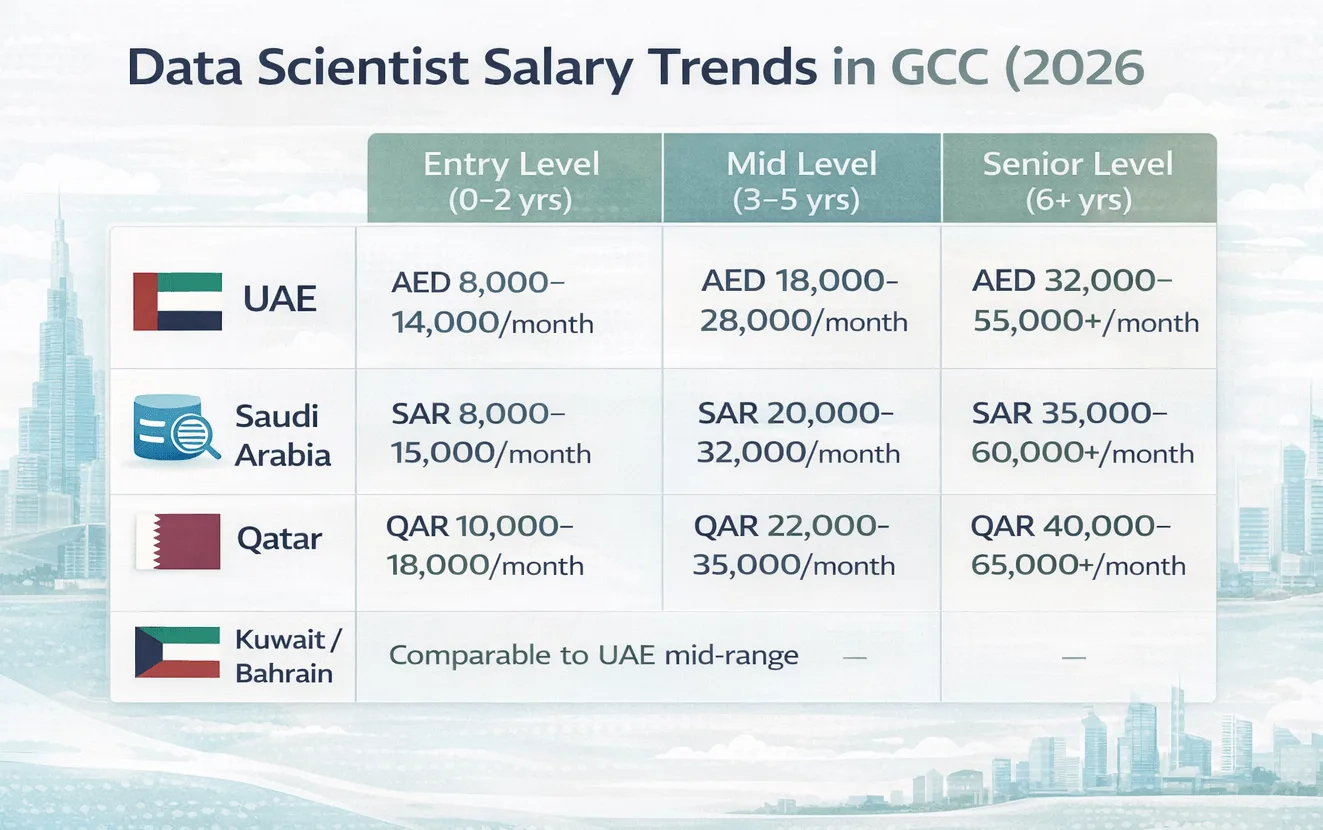
| Country | Entry Level (0–2 yrs) | Mid Level (3–5 yrs) | Senior Level (6+ yrs) |
|---|---|---|---|
| UAE | AED 8,000–14,000/month | AED 18,000–28,000/month | AED 32,000–55,000+/month |
| Saudi Arabia | SAR 8,000–15,000/month | SAR 20,000–32,000/month | SAR 35,000–60,000+/month |
| Qatar | QAR 10,000–18,000/month | QAR 22,000–35,000/month | QAR 40,000–65,000+/month |
| Kuwait / Bahrain | Comparable to UAE mid-range | — | — |
Figures are indicative market ranges based on 2025–2026 GCC job market data. Actual packages vary by employer, industry, and individual negotiation.
What Factors Affect a Data Scientist’s Salary in the GCC?
Three variables move the needle most significantly:
Experience and portfolio — proven project delivery, especially on production systems (not just Kaggle notebooks), commands a premium across all GCC markets.
Domain specialisation — data scientists with sector expertise in banking, healthcare, or oil and gas earn 20–35% more than generalists at equivalent experience levels.
Certifications and education — a master’s degree or a recognised professional certification meaningfully increases starting salary offers, particularly in government-linked organisations.
What Are the Common Challenges Beginners Face — and How Do You Overcome Them?
How Do You Get Data Science Experience Without a Job?
The most common beginner trap: employers want experience, but experience requires a job. The solution is to manufacture experience deliberately. Build a project using public GCC data. Contribute to an open-source repository. Volunteer your skills with an NGO or a university research team. A GitHub portfolio with three strong projects is more persuasive than a CV that lists courses.
How Do You Avoid Tool Paralysis in Data Science?
The ecosystem is enormous: Python, R, Spark, TensorFlow, PyTorch, Keras, dbt, Airflow, and dozens more. Beginners get paralysed. The rule: go deep before you go wide. Master Python and SQL first. Add machine learning. Add one visualisation tool. Only branch out once the core is solid.
How Do You Connect Data Science to Real Business Problems?
Technical skills without a business context produce models that nobody uses. Read industry reports for your target sector. Follow GCC business news. Attend sector-specific events — many UAE and Saudi industry conferences now have data and AI tracks. Build the habit of asking “what decision does this data need to support?” before opening a Jupyter notebook.
What Is the Future of Data Science Careers in the GCC?
How Are AI and Data Growth Shaping the UAE and Saudi Job Markets?
The GCC’s AI and data market is projected to grow significantly through 2030, driven by government spending, private sector digital transformation, and an expanding startup ecosystem. The UAE alone has announced AI investments running into billions of dirhams. Saudi Arabia’s NEOM project, the 2034 World Cup infrastructure programme, and the expansion of ARAMCO’s data capabilities all represent sustained, large-scale demand for data talent.
Which Industries Offer the Most Data Science Opportunities in the GCC?
Finance and banking — UAE and Saudi banks are among the most aggressive adopters of ML-driven credit scoring, fraud detection, and customer personalisation. ADIB, Emirates NBD, and Al Rajhi Bank all have active data science functions.
Healthcare — as explored in detail in our GCC healthcare data science guide, the region’s chronic disease burden and digital health ambition are creating sustained demand for health data analysts and clinical ML engineers.
Oil, gas, and energy — ARAMCO, ADNOC, and QatarEnergy are deploying predictive maintenance, reservoir simulation, and supply chain analytics at an industrial scale, creating highly paid specialist roles.
Final Thoughts: Start Your Data Science Journey Today
How to become a data scientist in 2026 is a question with a clear, learnable answer — but it requires honest commitment to the roadmap. Statistics first. Python second. Real projects from day one. A portfolio that demonstrates your thinking, not just your code. And sector knowledge that makes your technical skills land in the right context.
The GCC is one of the best-positioned regions in the world to reward that commitment. Government investment, private sector ambition, and a genuine shortage of qualified data professionals have created a market where a well-prepared candidate can move fast.
Start with one course. Complete one project. Push it to GitHub. The journey compounds quickly — the first step is the only one that requires deciding.
🔗 Explore our recommended data science training programmes for GCC professionals → 🔗 Talk to our team about corporate data science upskilling for your organisation →
FAQ:
How long does it take to become a data scientist from scratch?
Most learners reach a job-ready standard in 12–18 months of consistent study, combining online courses, self-directed projects, and a portfolio. Those with existing programming or statistics backgrounds can compress this to 6–9 months.
Is Python or R better for data scientists in the GCC?
Python. The overwhelming majority of GCC job postings specify Python. R has value in academic and pharmaceutical research contexts, but for general industry roles across UAE, Saudi Arabia, and Qatar, Python is the practical choice.
Do I need a degree to become a data scientist in the UAE?
Not necessarily. Many UAE employers, particularly in startups and consultancies, prioritise portfolio and skills over formal credentials. However, larger corporations and government-linked entities often require a bachelor’s degree in a quantitative field. A professional certification can partially compensate for the lack of a degree.
What is the best data science certification for UAE job seekers?
The Google Data Analytics Certificate and IBM Data Science Professional Certificate on Coursera are the most frequently recognised by UAE hiring managers. For more senior roles, the Microsoft Azure Data Scientist Associate or AWS Machine Learning Specialty certifications carry additional weight.
Are there data science jobs in Saudi Arabia for non-Arabic speakers?
Yes — particularly in multinational companies, Vision 2030-aligned projects, and technology firms based in NEOM or the Diriyah Gate Development Authority. English is the working language in most corporate and tech environments across the Kingdom.
Where can I find official data science career guidance for the GCC?
The UAE Ministry of AI and Digital Economy, the Saudi Digital Academy, and the World Economic Forum’s Future of Jobs Report all publish authoritative, regularly updated guidance on data science career pathways and in-demand skills.
Further reading: WEF Future of Jobs Report